
Omdia Technical First Look
Omdia has confirmed it: NetFoundry makes microsegmentation practical. Here's what they saw.
Only 24% of organizations have deployed microsegmentation extensively. Omdia's new Technical First Look explains why the rest stall, and how NetFoundry's identity-based approach segments workloads and AI agents incrementally, without rewriting firewall rules or risking downtime.
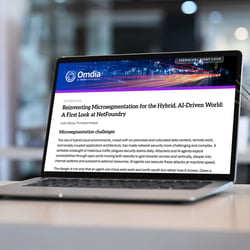
Reinventing Microsegmentation for the Hybrid, AI-Driven World
Justin Boyer, Principal Analyst, Omdia
October 2026 · 8 pages
Get the free Omdia report
Instant access on the next page.
8 pages, about a 10-minute read.
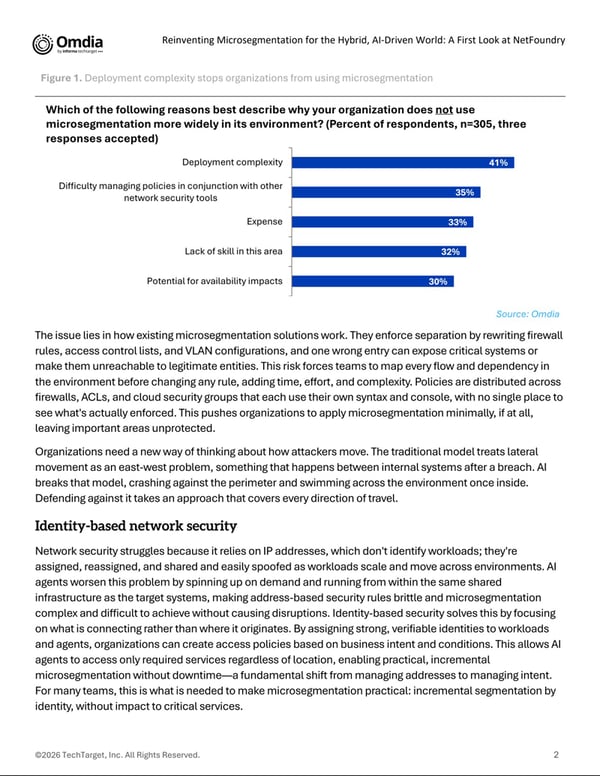
cite deployment complexity as the top reason they don't use microsegmentation more widely
use microsegmentation only moderately or on a limited basis
are concerned about attackers using AI to scale attacks
Source: Omdia, Network Security at a Crossroads: Reclaiming Relevance in Hybrid, Cloud-native Environments, August 2026.
The problem
Microsegmentation works. Deploying it is the problem.
Traditional segmentation is built from firewall rules, ACLs, VLANs and cloud security groups, each with its own syntax and console. One wrong entry can expose a critical system or knock it offline, so teams map every flow before touching a rule, and most never get past a few protected zones.
Meanwhile AI agents spin up on demand, inherit broad permissions and move at machine speed, east-west and north-south. IP-based rules can't keep up with workloads that don't stay put.
Inside the report
What Omdia found
- Why address-based segmentation breaks in hybrid, multicloud and agentic AI environments
- How identity-based policy replaces firewall rules, ACLs and VLANs, covering east-west and north-south traffic in one model
- The live demo: a Kubernetes workload on Google Cloud in the US reaching a private AWS API in Singapore. One tag removed, access revoked, and the API went silent: no response, not even an error
- NetFoundry as a compensating control for hard-to-patch and critical assets in regulated environments
- Governing AI agents with their own identities, plus LLM and MCP gateways
Why it's different
Segmentation built on identity, not network topology
Identity, not IP
Every workload and AI agent gets its own cryptographic identity, even when several share one IP address or machine.
No inbound ports
All connections are outbound to the fabric. If an identity isn't authorized, the endpoint is invisible to it.
Segment at your own pace
Tag-based policies let you protect one service or an entire subnet, incrementally and without downtime.
Your data stays yours
Single-tenant, end-to-end encrypted, no TLS termination. NetFoundry can't read your traffic, even when hosting the fabric.
If your organization is looking to segment its network or apply zero trust to workloads and agentic AI and better defend against modern threats, Omdia suggests that you seriously consider NetFoundry.
Justin Boyer · Principal Analyst, Omdia
Written for CTOs, CIOs, CISOs, cloud security architects and platform engineers planning segmentation or Zero Trust for workloads and AI agents.
See microsegmentation without the rewrite.
Read Omdia's independent look at how NetFoundry secures workloads and AI agents by identity.
Download the free reportThis Technical First Look from Omdia was commissioned by NetFoundry and is distributed under license from TechTarget, Inc. © 2026 TechTarget, Inc. All rights reserved.